
Where to Eat in Split: Best Konobas & Local Restaurants
Where to eat in Split: family konobas in Varoš, the late-morning marenda, how fish is priced by the kilo, the two markets and who closes on Sundays.
Walk three lanes inland from the Riva and dinner gets noticeably cheaper and usually better. Split’s good eating sits in Varoš, around the two markets and in the residential streets away from the palace: family konobas with six tables, a menu that moves with the morning catch, and the awkward habit of closing on a Sunday or a Monday. Two moves save most visitors from a mediocre meal - book a day ahead, and eat your big plate at midday rather than at eight in the evening.
A konoba isn’t a different cuisine from a restoran. The word promises stone walls, a family in the kitchen and folksy decor, but the cooking is the same Dalmatian repertoire, and plenty of places on the tourist drag borrow the name without the substance. What marks out the ones locals fill: a short menu that changes, fish shown to you before it’s cooked, prices per kilo written up rather than mumbled, and a room that’s busy at 13:00 on a Tuesday.
Eat your big meal at midday
For Croatians lunch is the main meal of the day, not dinner, and the coast has a name for the meal that bridges the gap: marenda (inland it’s gablec). It runs roughly from 10:30 until noon, portions are smaller than a full main course, and it’s comfortably the cheapest hot meal you’ll eat all day. Konobas that do a proper marenda write it on a board rather than a menu, because it’s whatever the kitchen cooked that morning: brudet, tripe, stuffed peppers, pašticada if you time it right.
The practical consequence: the same kitchen, the same cook and the same pot cost far less at 11:30 than at 20:30. If your budget is tight and you still want to eat the real thing, that’s the swap to make. Cafes here open absurdly early, sometimes at 6:00, though they won’t pour you anything alcoholic before 9:00 - so coffee at dawn, a marenda late morning, then a swim is a completely normal Split day.
How fish is priced
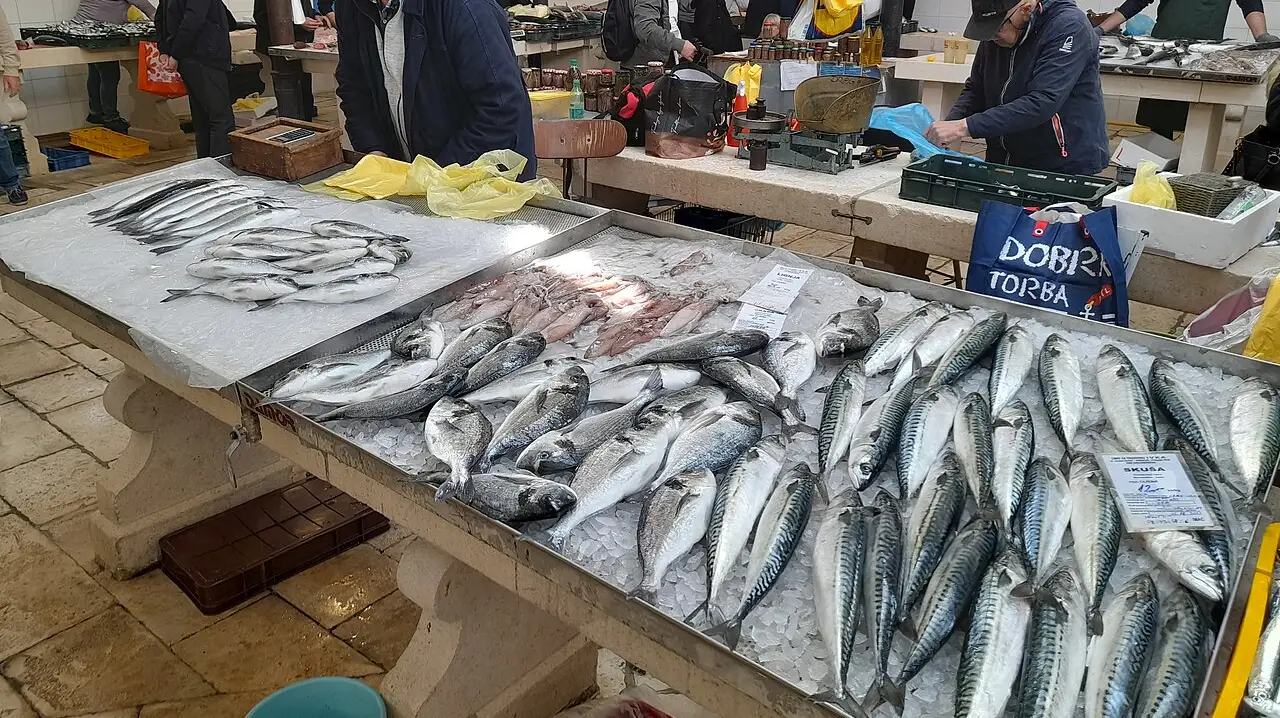
This is where visitors most often get a shock at the end of the meal. Good whole fish is sold by weight, not by the plate. You choose from a tray or a chiller, it goes on the scales, and the bill is that weight multiplied by a price per kilogram that varies enormously by species and by how touristy the room is. Nobody is cheating you; it’s simply how the Adriatic coast has always sold fish.
The move that prevents an argument: ask them to weigh the fish in front of you and tell you the total before it goes on the grill. Any honest kitchen does this without blinking.
There’s a second tier nobody mentions to visitors, and it’s what locals order midweek. Cheaper fish - plava riba, the oily kind like sardines and mackerel, and girice, tiny whitebait fried whole - is normally priced per portion, not per kilo. You get a plate of it with chard and potato for a fraction of the price of a sea bass, the bill can’t surprise you, and on a hot evening it’s honestly the nicer thing to eat.
The konobas locals still use
Konoba Fetivi (Tomića stine 4, in Varoš) is the reference point: a small family room in the old fishermen’s quarter, market fish cooked simply, and a Michelin Bib Gourmand. It closes on Mondays and it’s genuinely small, so ring ahead rather than turn up.
No booking and it’s already eight in the evening? Villa Spiza (Kružićeva 3, inside the palace) is famously walk-ins only. The menu is chalked up daily from whatever the market had - grilled fish, gregada, black risotto, home-made pasta, calf’s liver, lamb with peas, wild boar with gnocchi - and you eat beside an open kitchen. It’s run by Ivana Gamulin, daughter of the Split chef Nikica Gamulin, with her sister on desserts. In summer the wait can reach two hours, and no dinner is worth two hours on your feet: go at opening or at midday, when the same kitchen has no queue, and if the lane is already full at 20:00 in August, walk five minutes into Varoš to Matejuška or Fetivi instead. Closed Sundays.
Konoba Matejuška (Tomića stine 3) is five or six tables in a nineteenth-century house below street level, seafood by weight, no theatre. Reserve or arrive early; there’s nowhere to wait.
If the budget is what decides, Buffet Fife (Trumbićeva obala 11) is the answer: a canteen by the Matejuška fishermen’s harbour, long shared tables, service without ceremony, big cheap plates of brudet, pašticada, tripe and fried fish. Calibrate, though: Fife is the most oversold meal in town if you come expecting a great dinner rather than a cheap one.
Half the table doesn’t eat fish, or you’re out with children? Konoba Korta (Poljana Grgura Ninskog 3) is the one inside the palace walls we still send people to: a stone courtyard, pašticada, peka and crni rižot, plus vegetarian and gluten-free options, which are thin on the ground in old-school konobas. It sits in the busiest part of town, so eat early or reserve.
If you only get one dinner here, make it Fetivi: a Bib Gourmand flags exactly this, good cooking at a normal price, and Varoš is the version of Split people come back for. Matejuška is the fallback when Fetivi is full or shut on a Monday, Villa Spiza if you’d rather watch an open kitchen than sit quietly, Korta if the group needs options, Fife if the bill is the point.
Cheap, fast and good
Hungry at an hour when the konobas have stopped serving? Kantun Paulina (Matošića 1) grills ćevapi and serves them in bread with onion, to take away and eat on a bench. It runs from early until late, the queue moves fast, and the hours shift with the season.
Pizzeria Galija (Tončićeva 12) claims the oldest pizza in town, still baked in a wood-fired oven to a recipe the family dates to 1980. Unfashionable, consistently full, and about as close as the centre gets to a neighbourhood canteen.
Kruščić (Obrov 6, beside the fish market) is a small artisan bakery working with unbleached flour and no additives, turning out French and German-style loaves and pastries. It bakes in the morning, sells out, and takes cash only - a breakfast plan, not a lunch one.
Bobis has been baking in Split since 1949, when the first shop opened on the Pjaca, and its chocolate-covered doughnut has been on the counter since 1962. Outlets are all over town, including the Riva. For coffee that’s more than chair rental, D16 on Dominisova roasts its own beans inside the palace.
The two markets
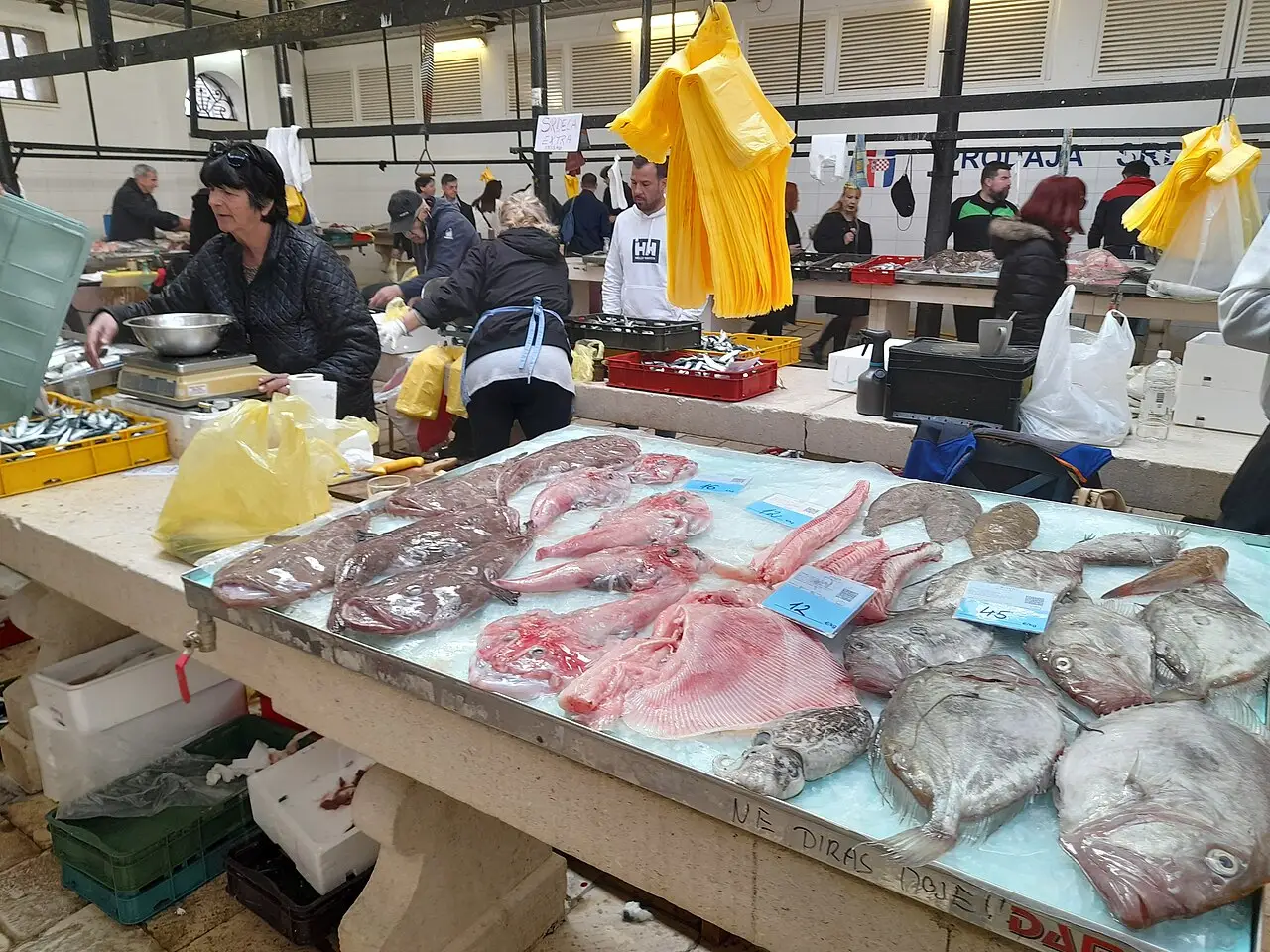
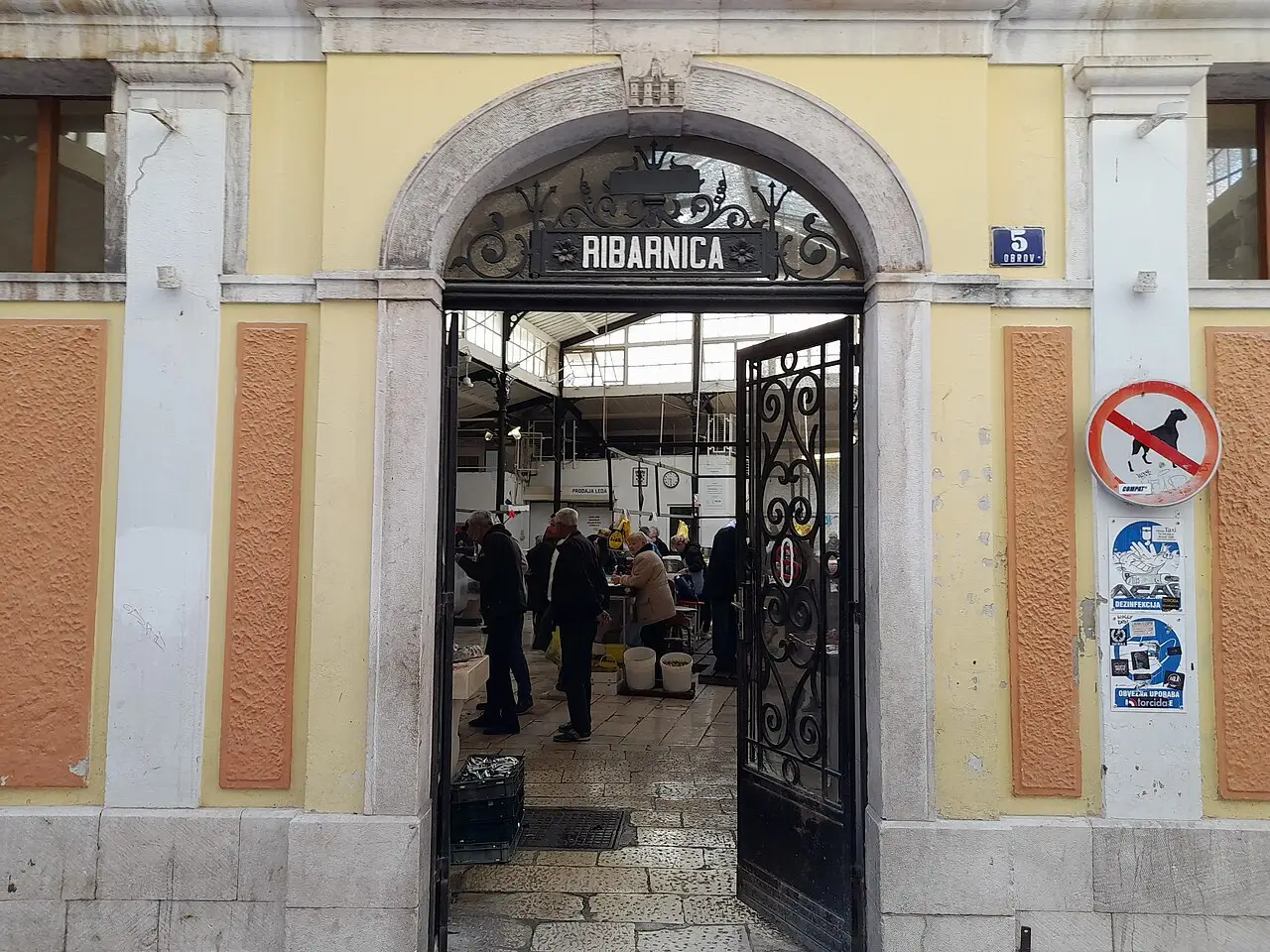
The fish market, the Peškarija, is a couple of minutes west of the palace, on Obrov. The city’s own tourist board calls it one of the central points of daily life in Split, and the Secession building it trades in is more than 120 years old. It comes with the town’s favourite piece of trivia: there are no flies, apparently because of the sulphur spring next door - the same water said to have drawn a rheumatic Diocletian here in the first place. Trading is a morning affair; by early afternoon the slabs are being hosed down.
The green market, Pazar, runs along the eastern palace wall around the church of St Dominic, and it’s the better of the two for a self-catering breakfast: tomatoes, figs, olive oil, cheese, pršut and sometimes soparnik, the flat chard pie from Poljica near Omiš that carries an EU protected geographical indication. Both markets keep morning hours and wind down in the early afternoon, and at both of them cash is simpler than a card.
When you want the big dinner
K.užina (Kraj Svete Marije 1) is the sensible splurge: creative Dalmatian cooking in a quiet lane off the main square, a Bib Gourmand in the 2026 Michelin guide to Croatia, open Monday to Saturday from midday and closed on Sundays.
ZOI (Obala Hrvatskog narodnog preporoda 23, on the Riva) is the top of the market inside the old town - a terrace at the edge of the palace looking over the harbour, 17/20 from Gault&Millau, tasting menus from three to seven courses alongside a la carte, dinner only. Prices move with the season and aren’t published, so ask for the number when you book. Take it for an occasion; if what you actually want is grilled fish and a jug of house wine, you’ll be happier in Varoš.
Zrno Soli sits above the ACI marina at Uvala Baluni 8, looking back at the city across the yachts, with 16.5/20 and a kitchen that does clever things with octopus and shellfish - the choice when you want to look at the old town rather than sit inside it. Dvor (Put Firula 14) is the quiet one: a seaside terrace in the residential south of the city, 16/20, and nobody with a cruise-ship lanyard walking past your table.
One dinner needs planning rather than money. Peka - meat or octopus baked under an iron bell in embers - must be ordered hours ahead, a full day ahead on islands like Vis and Brač in peak season, and it’s cooked for a minimum of two people. Our guide to peka explains how to book it and what it should cost.
What to order by season
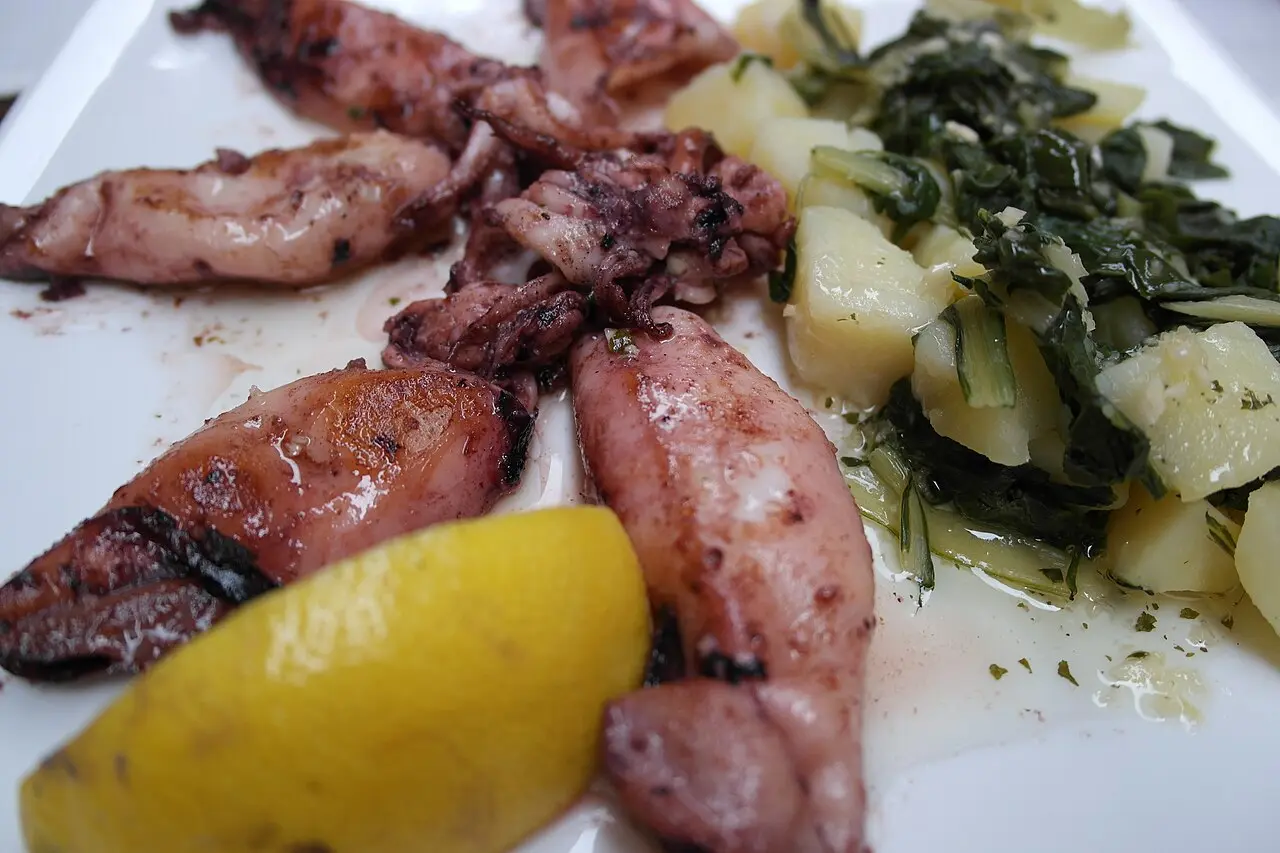
Split’s menus barely change through the year, but a few things are worth timing. Oysters from Mali Ston are at their best from March to May, and the oyster festival in Ston is tied to the feast of St Joseph on 19 March each year - in 2026 it ran 19-22 March, and the organisers post the 2027 dates nearer the time. In high summer the sensible order is the simplest one - grilled fish or squid, chard and potato, a jug of house wine - because the kitchens are running flat out in the heat and elaborate dishes are where corners get cut.
For the dishes themselves, from crni rižot to pašticada and fritule, our guide to what to eat in Croatia goes through them one by one, and the Croatian wine guide covers what to drink with them: Plavac Mali with red meat and peka, a coastal white with anything from the sea.
Where you sit changes the bill
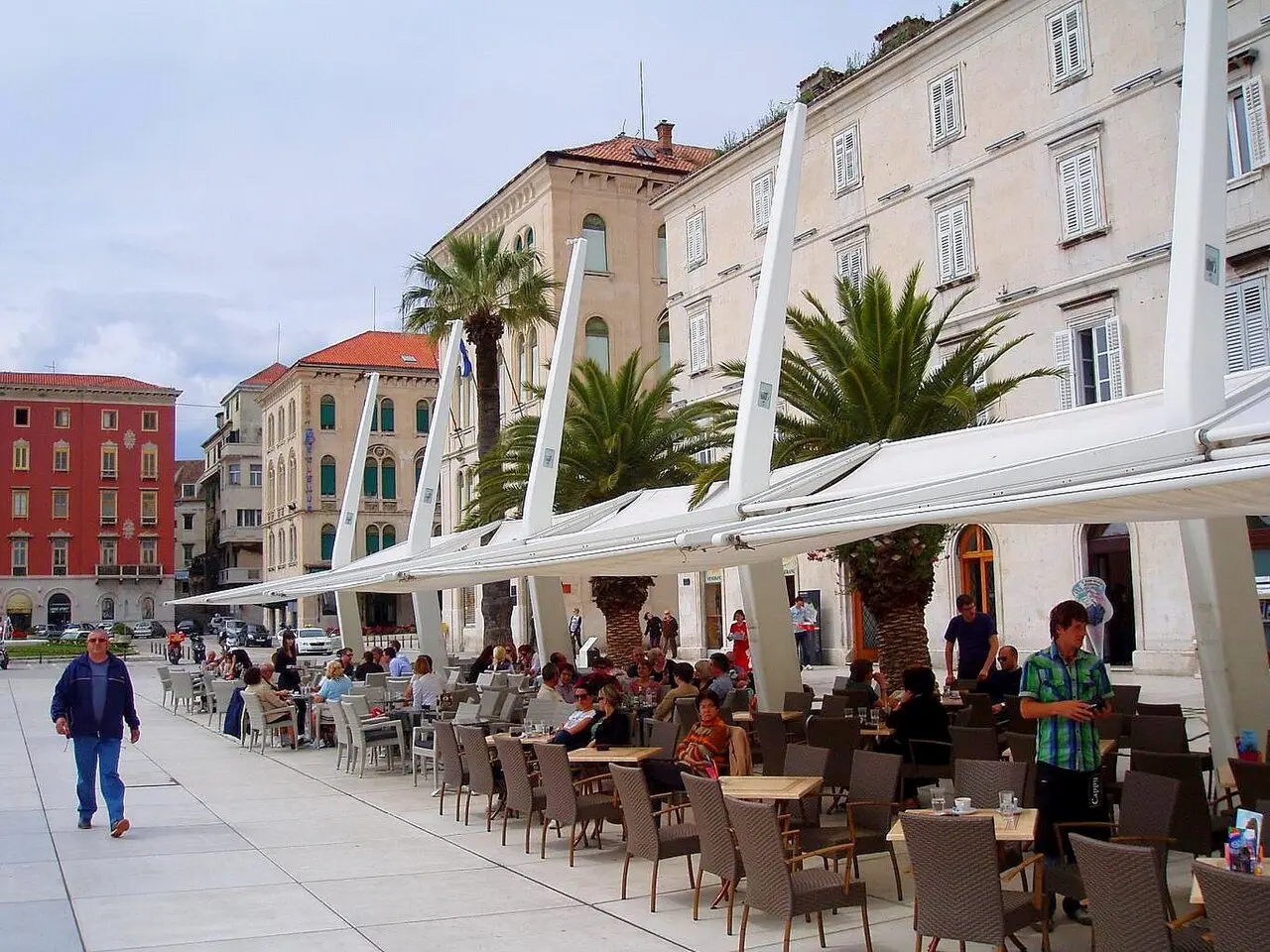
The terraces on the Peristyle and along the Riva are a fine place to drink a coffee and a poor place to eat dinner, because you’re effectively paying rent on one of the most photographed courtyards in Europe. Three minutes’ walk into Varoš or up towards the markets, the same fish costs meaningfully less.
As a budget anchor, a sit-down dinner with a drink at a mid-range place runs about 20 to 35 euros a head, and a coffee on a terrace is 2 to 3 euros; our Croatia trip cost breakdown has the wider picture. Cards work almost everywhere, but carry some cash for the markets, the bakery and the smaller konobas. Tipping is appreciated rather than expected: round up to about 10% for good service, ideally in cash, and check it’s not already on the bill - the detail is in our cash or card guide.
What goes wrong
- Turning up on a Sunday and finding the good places shut. Fetivi closes Mondays, Villa Spiza and K.užina close Sundays, Kruščić bakes Monday to Saturday. Plan the special dinner for a weekday.
- Arriving at 20:30 with no reservation in July. The rooms people recommend hold five to twelve tables each.
- Ordering the day’s fish without asking the weight. Thirty seconds of conversation, no unpleasant surprises.
- Eating the main meal on the waterfront at night - the most expensive combination of place and hour in the city.
- Expecting peka on demand. It needs a phone call in the morning for that evening.
Split rewards planning more than most Croatian cities: the good rooms are tiny and the tourist volume is enormous. Book one konoba dinner, keep one midday marenda in the plan, buy breakfast at the markets, and you’ll eat better here than in far more expensive towns along the coast. Our Split travel guide covers the rest of the city, Split nightlife picks up where dinner ends, and the food directory lists the places we’ve checked.
Opening days, seasonal hours and prices change - confirm directly with the restaurant before you plan an evening around it. Prices quoted are typical ranges, not quotes from individual venues.
Photos
Read also

Food · 14 min read
Truffle Hunting in Istria: Tours, Season & What to Expect
Updated · September 3, 2026Istria truffle hunts: the legal collecting window for each species, how a hunt runs, real prices from 15 EUR, the 2026 fair dates and truffle prices.

Food · 9 min read
Peka: Croatia's Under-the-Bell Dish & Where to Try It
Updated · July 23, 2026What Croatian peka is, how to order it (2-24 hours ahead, minimum two people), what it costs, and which konobas across Dalmatia still cook it.

Food · 8 min read
Croatian Wine Guide: Regions, Grapes & Tastings
Updated · July 12, 2026Croatian wine explained: Plavac Mali and Dingač, Istrian Malvazija, Slavonian Graševina, the Zinfandel link, and how to taste it on the wine roads.

Food · 13 min read
What to Eat in Croatia: Food & Wine Guide
Updated · July 31, 2026What to try in Croatia: peka, pašticada, black risotto, buzara, brudet, Pag cheese, pršut, Istrian truffles, štrukli, plus Plavac Mali and Malvazija wine.