
Split Nightlife 2026: Bars, Clubs, Hours & Prices
Split nightlife by area: palace wine bars, clubs from 22:00 (Central from midnight), Bačvice beach bars, what a drink costs and how to get home after.
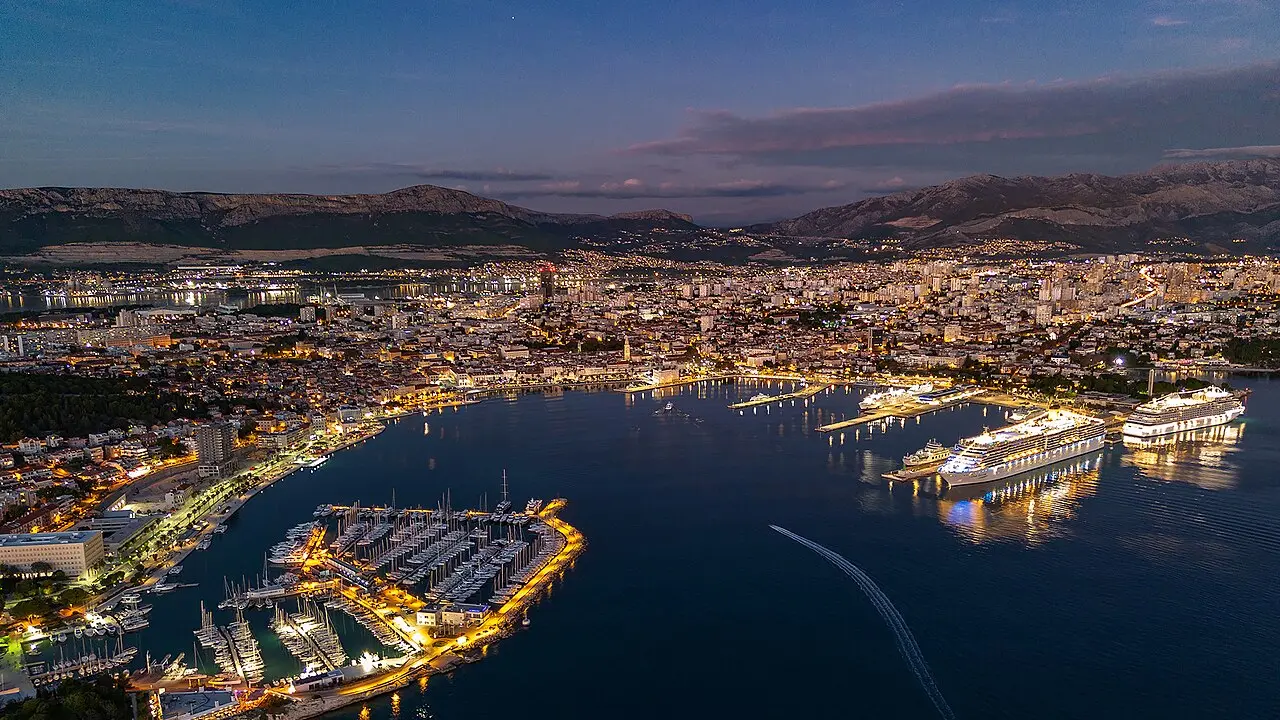
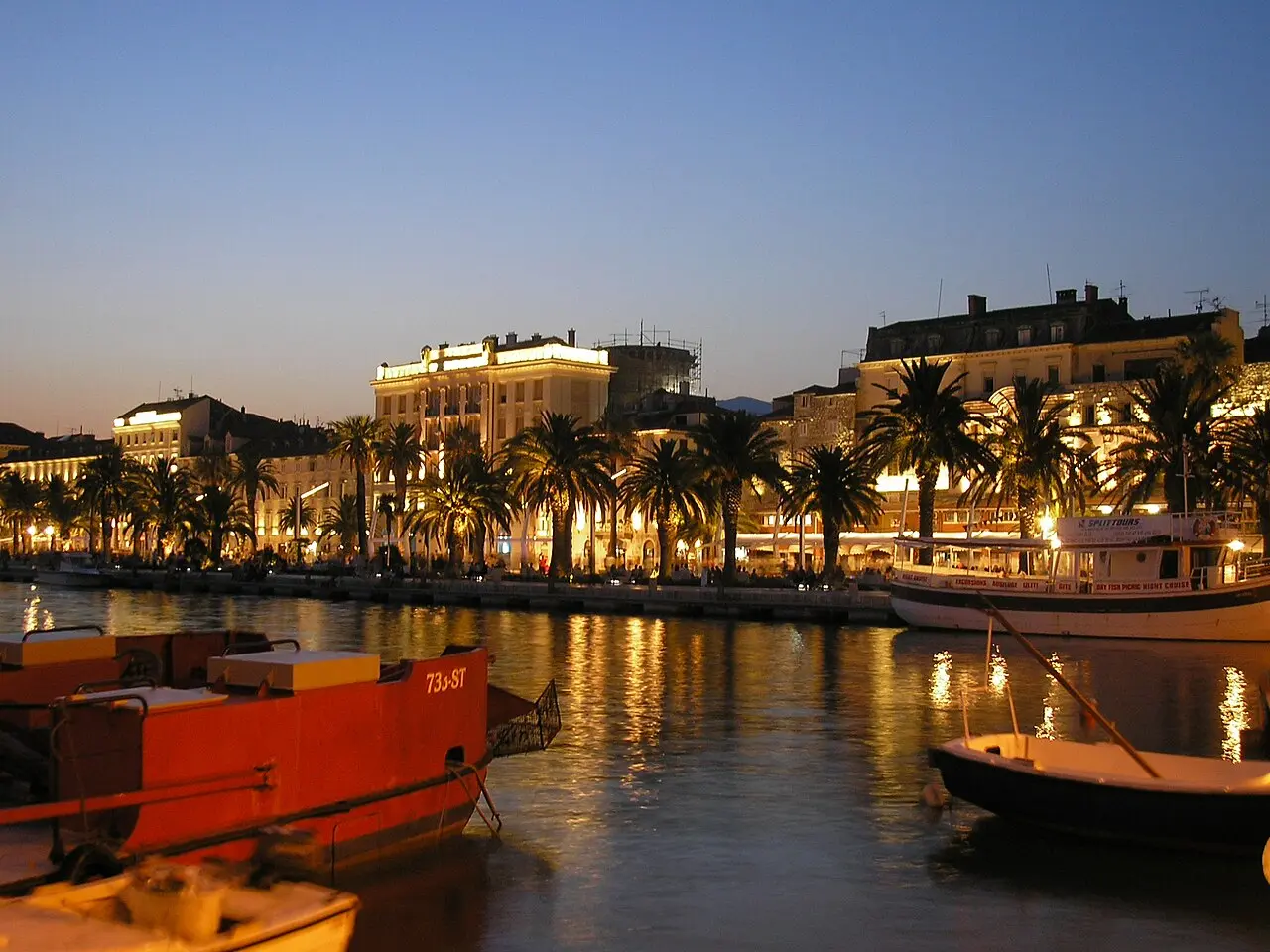
Split goes out late and outdoors. The night starts on the Riva, the palm-lined seafront where the whole city strolls at dusk, then moves into the candle-lit lanes of Diocletian’s Palace, where stone Roman courtyards now hide wine bars and cocktail spots. For louder nights, head east to Bačvice, the sandy bay whose beachfront is lined with bars and the city’s best-known clubs. There is no single “club district” - you bar-hop on foot through the old town and finish by the sea. Bars run from early evening until roughly 01:00; the clubs start later, from 22:00 at Boiler and only from midnight at Central, the biggest room in the centre, which publishes 00:00-05:00 every night. Croatia uses the euro (€); on the old-town menu we read on 22 September 2026, a half-litre of draught beer was €5.50 and the cocktails ran €12-15.
What changes everything is the season. In July the beach clubs run till dawn; in November it’s locals over wine in a stone lane. Knowing which Split you’re visiting saves a lot of wandering.
Where to go out: the main areas
Split’s nightlife splits cleanly into three drinking areas plus the club streets just outside them, all walkable from each other in a single evening - which is how locals do it.
| Area | Vibe | Best for | Rough hours |
|---|---|---|---|
| Diocletian’s Palace / old town | Atmospheric, intimate, stone lanes | Wine bars, cocktails, an early-evening drink | 18:00-01:00 |
| The Riva | Open-air, see-and-be-seen, busy | People-watching, a first or last drink by the sea | 08:00-01:00 |
| Just west and north of the palace | Dressed-up club rooms indoors | Big-name DJ nights, dancing | 22:00-05:00, Central from 00:00 |
| Bačvice | Loud, late, beachfront | Beach bars and clubs that run until dawn | Day into the small hours |
Diocletian’s Palace and the old town
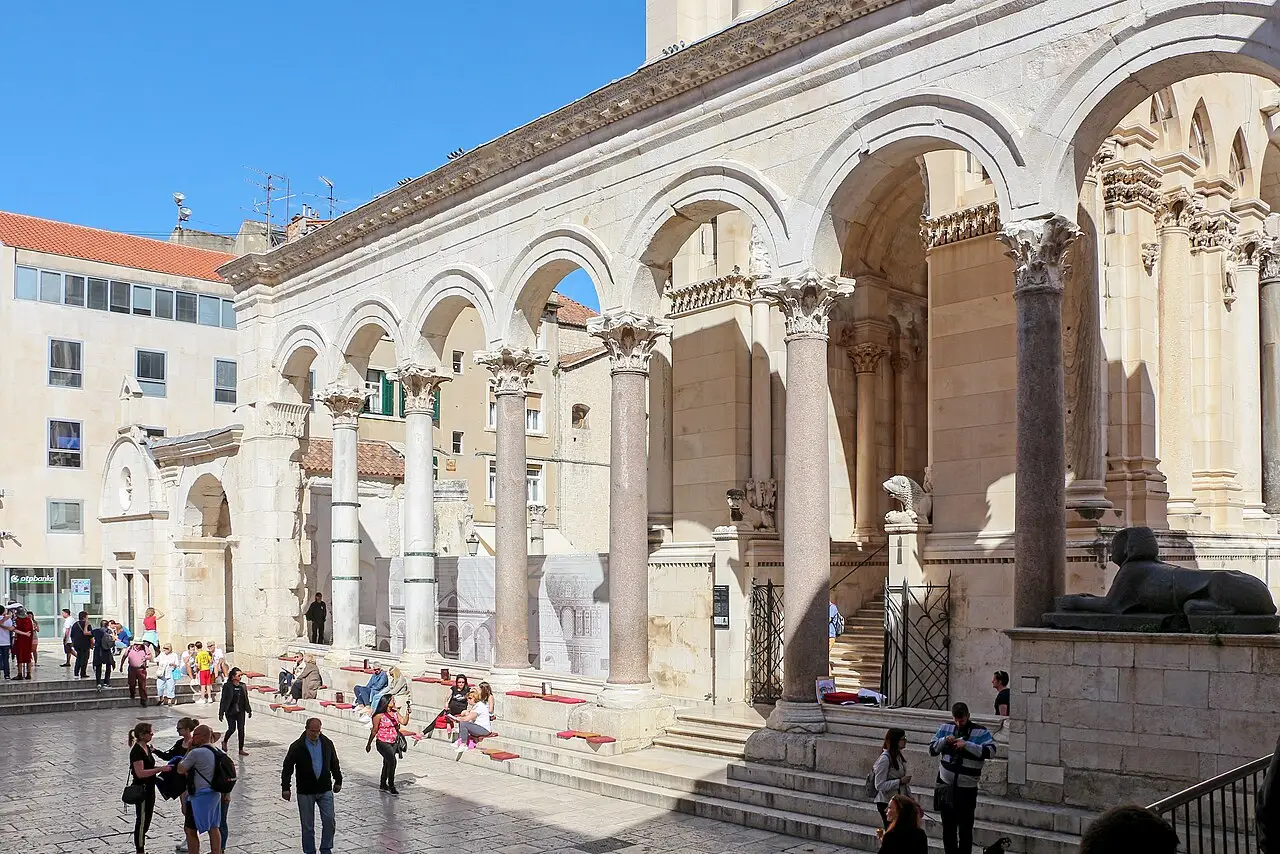
The 1,700-year-old palace isn’t a museum behind a fence - it’s a living quarter of bars, cafés and apartments built into the Roman walls. The lanes around the Peristyle, the Vestibule and the hidden squares (Dosud, Dobrić, the streets off the Pjaca and Voćni trg) fill with terrace tables after dark: small candle-lit places where you sit on worn stone with a glass of Plavac Mali. The local ritual is a drink on the Peristyle’s marble steps, where bar staff bring cushions and a DJ or live singer plays into the columns.
The Riva
The Riva (officially the Obala hrvatskoga narodnog preporoda) is the wide promenade along the south wall of the palace. No clubs, but every evening begins here: the city comes out for the špica stroll, the terraces face the boats and the island skyline, and it’s the natural place for a first sundowner or a last quiet drink. Two minutes from the palace lanes, ten from Bačvice.
Bačvice
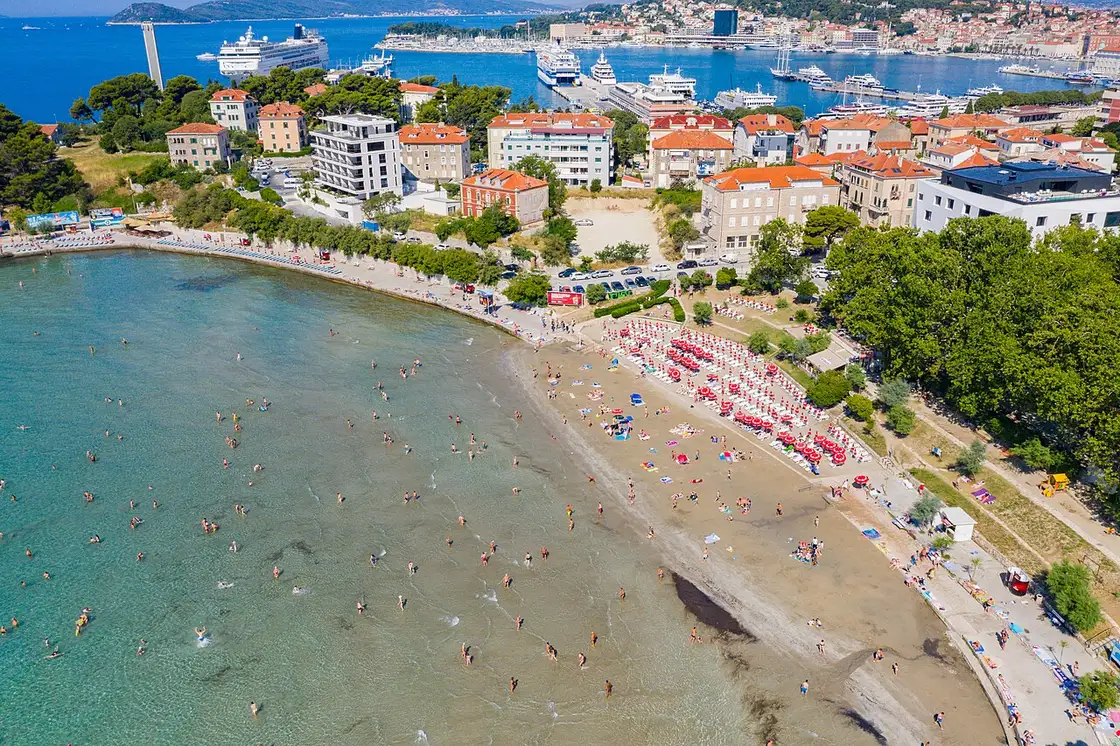
For volume and late hours, everyone heads to Bačvice, the shallow sandy bay just east of the ferry port (a 10-15 minute walk from the Riva). By day it’s the city beach and the home of picigin, the local shallow-water ball game; by night the crescent of buildings behind the sand turns into Split’s main cluster of beach bars and clubs, stacked on several levels. The seafront path here is Preradovićevo šetalište, and the tourist board’s nightlife register lists Caffe-Club Bačvice at number 2 on it. In summer this is where the city dances until the early hours. The beachfront has its own rhythm, safety quirks and history, all of which we take apart in the Bačvice beach bars and club guide. If you’re organising a group stag weekend rather than picking bars one by one, the beds, boat day and airport transfer sit in our Split stag do planning guide.
Split’s clubs are outside the palace
The confusing part for a first-timer is that Split’s real clubs are not in the palace at all. The tourist board’s nightlife register puts the biggest indoor rooms in ordinary streets a few minutes out of the old core:
- Central - Trg Gaje Bulata 4, the square by the Croatian National Theatre. The largest club in the centre, open every night from midnight to 05:00, with named guest DJs through the summer (Acraze on 6 August 2026, Le Twins on 13 August, DJ Katch on 20 August, Lunis on 21 August).
- Boiler - Marmontova 9, on the main pedestrian street west of the palace. Listings put it at 22:00-05:00 in season, which makes it the obvious room if you don’t want to kill two hours waiting for Central to open.
- Emperor’s Club 305 A.D. - Trogirska 7, a short walk west of the palace.
- Fabrique Pub - Trg Franje Tuđmana 3, a pub with a dancefloor rather than a club proper, and open from 10:00 until midnight midweek and 02:00 at weekends.
- Further out, the register also lists Mandrach (VIII mediteranskih igara 5, over towards Spinut), Moon Bar (Matice hrvatske 1, the nearest of them at about a kilometre from the Riva), CLO (Domovinskog rata 104b), Kauri (Poljička cesta 39) and Evergreen (Odeska 18). All five sit 1-3 km out in residential Split rather than on the tourist circuit, so budget a taxi each way.
Addresses and phone numbers for each are on visitsplit.com, and the register is the thing to check before you trust a blog list: Split’s club names change hands often, and the tourist board’s page is the one that gets updated.
Types of venue: wine bars, cocktails, clubs and beach bars
Wine bars. Dalmatia is serious wine country and the old town pours it: reds like Plavac Mali, Dingač and Babić, whites like Pošip and Maraština from the islands and Pelješac, usually with small plates of cheese, pršut and olives. The most relaxed way to start a night.
Cocktail and craft bars. Tucked into the palace lanes are intimate cocktail spots and a growing craft-beer scene. These are early-to-late venues - you’ll find them busy from around 21:00, and many stay open until 01:00 or 02:00.
Clubs. Split is not a mega-club city, and the hours are staggered rather than uniform. The midnight rule belongs to Central, which publishes 00:00-05:00 every night: arrive there at 22:00 and you’ll be standing outside a locked door. Boiler opens at 22:00 in season and Fabrique has been serving since morning, so an early start is possible - just not at Central. Expect house, pop and regional hits and smart-casual dress; what the door costs is in the price table below.
Beach bars. In summer the beaches are the venue. The bars along Bačvice and the coves under Marjan (Kašjuni) run day-to-night, sliding from sunbed service into DJ sets as the light goes: barefoot, by the sea, no cover charge until late.
Summer events and seasonality
Split’s nightlife is intensely seasonal. From late June to early September the city runs at full tilt: beach clubs open, terraces spill into the lanes. From November to March the scene shrinks to the year-round old-town bars, cosy but quiet, and the beach clubs close entirely.
The biggest fixture is Ultra Europe, the electronic-music festival at Park Mladeži stadium, usually a mid-July weekend (2026 ran 10-12 July; the 2027 dates are 9-11 July), drawing tens of thousands. Older guides promise island after-parties on Brač and Vis; the operator no longer lists them, so treat that as history until it reappears on the official site. Line-ups and dates change every year, so check the official site before planning around it.
Around it the city runs a full cultural summer: the Split Summer Festival takes mid-July to mid-August every year - the 72nd edition covered 14 July to 14 August 2026 - theatre and opera with several of the productions staged on the Peristyle itself, and the tourist board’s Summer colours of Split programme of open-air events ran from 22 July to 27 September in 2026 and repeats over roughly the same window each summer. In practice that means the palace has live music and an audience on ordinary weeknights in August, which is a better night out than queuing for a club. For festival timing across the country, month by month, see our Croatia festivals calendar.
Tip: for the buzz without the Ultra-weekend crush and prices, aim for June or early September - beach bars open, sea warm, city far less packed than peak July-August.
Getting home: taxis, apps and walking
Split’s nightlife is compact: old town, Riva and Bačvice are within a 15-minute walk, so most nights you walk home over the worn palace stone (proper shoes - it’s slippery). For anything further out, or in the small hours:
- Ride-hailing apps. Both Bolt and Uber list Split on their own coverage pages, and both beat haggling for a fair price at 03:00.
- Taxi ranks sit by the Riva, the ferry port and the bus and train station; agree the fare or insist on the meter before you set off, because there is still no national ceiling on what a Croatian taxi may charge. A draft rule put out for consultation in July 2026 would hold the start to €10 and the kilometre to €2.50, but it had not been published in Narodne novine when we checked in September 2026. Even if it lands, it isn’t a bargain by law: a 3 km hop would still be allowed to cost €17.50.
- Buses are not the plan. The Promet Split city network thins right out after midnight, so don’t build a night around catching one home from a club on the edge of town.
If you’re sleeping on the islands or in a coastal town, the last ferries and catamarans leave in the evening - there’s no late boat back, so either stay in Split or read the timetable carefully. For how ferries and buses work, see our transport hub.
The rule that surprises visitors: no drinking on the street
Carrying a drink between bars feels normal on the Riva - it isn’t legal in Split’s old town. Under the city’s Odluka o javnom redu i miru (public order bylaw), adopted by the City Council in 2023, drinking alcohol on a public surface or climbing on a monument or memorial plaque carries an on-the-spot fine of €300, cut to €150 if you pay within three days. The useful part is where the line actually falls. The ban covers the whole of zone A, the Riva included, and a 100 m radius around every school and kindergarten in the city - but licensed terraces are exempt from it, and so is the whole ban while an official city event is running - article 4 suspends it for gradske manifestacije. So the same drink is perfectly legal at the table outside the bar and a €300 problem ten steps later on the promenade. City wardens enforce it in the historic core, and “just one beer walking to the next bar” is exactly the situation it targets.
Since 2026 a second rule targets the shop run rather than the drinker. From 1 June to 15 September, shops, kiosks, stalls and vending machines anywhere in Split may sell alcohol only between 06:00 and 21:00, under a city decision adopted on 29 July 2026 (Službeni glasnik Grada Splita 36/2026). Bars and restaurants aren’t on its list of outlets, so after 21:00 in summer the next drink comes from a bar. In 2026 the decision took effect on 19 August; it sets no end date, so unless the council changes it, it covers the whole window from 2027.
What a night out costs
Croatia is not the cheap night it was, and the shop is no refuge: retail alcohol runs at 125.6 against an EU average of 100 (Eurostat 2024), so the pre-drinks trick that works in Prague or Sofia barely moves the needle in Split. Where the wider trip budget lands is in how much a trip to Croatia costs.
| Item | Typical 2026 price |
|---|---|
| Local beer (0.5 l), draught | €5.50 |
| Aperol spritz | €10 |
| Cocktail | €12-15 |
| Vodka measure | €3.50 |
| Club entry | No published door prices; free or cheap early at Boiler (opens 22:00), cover charge on headline-DJ nights |
Every drink price above comes off one old-town menu - Konoba Varoš, Ban Mladenova 9, read on 22 September 2026 - so confirm on the spot: venues reprice every season, and Ultra weekend is its own economy. What you’re really paying for is the setting: a glass on the Riva or the Peristyle costs noticeably more than the same glass a few lanes back, and a €12 Hugo is more than five €2.20 coffees off that same Varoš list. Cards are widely accepted, but carry cash for small bars and beach kiosks.
Split vs Hvar: which is the bigger party?
Hvar Town, an hour from Split by catamaran, is the glamour party island: marina-front clubs, after-beach parties on the Pakleni Islands, a younger international yacht-and-cocktail crowd. More concentrated and more famous than Split, but pricier and more seasonal.
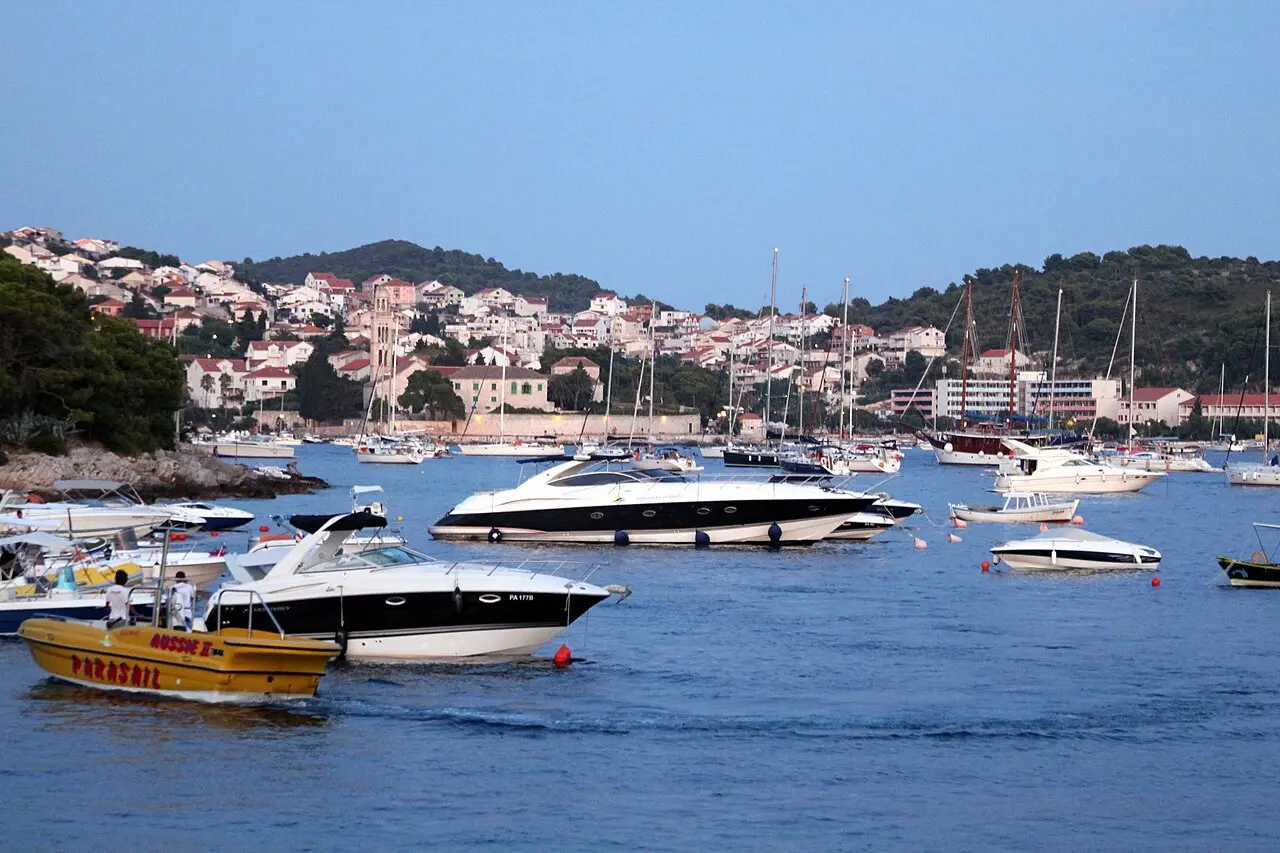
Split is the better all-rounder: more variety (Roman-lane wine bars, cocktail spots, beach clubs, big festivals), a longer season, cheaper, and you don’t need a boat to get home. The classic move is to base yourself in Split and take a day-and-night trip to Hvar when you want the full party-island version. More island context in our Split travel guide and the cities hub. Further south, Dubrovnik’s nightlife is smaller and walled in, built around a club inside a fortress and sunset drinks on the rocks below the sea wall.
From dinner at 20:00 to a 05:00 finish
Dinner around 20:00 - where to eat in Split and the Split food directory cover that end of it. A drink on the Riva while the light goes. The palace lanes from about 22:00 until they thin out around 01:00. Then the fork: Bačvice if you want the sea and the beach bars, Central or Boiler if you want a room, a DJ and a 05:00 finish. The Split travel guide has the daytime version of the same city, the entertainment hub covers festivals and beaches across Croatia, and the transport hub is there for getting around after dark.
Opening hours, prices, timetables and seasonal services change through the year - the figures here are planning estimates, not quotes. Confirm current details with the operators and official sources before you go.
Photos
Read also

Entertainment · 9 min read
Dubrovnik Nightlife: Revelin, Cliff Bar & Getting Home
Verified · October 3, 2026Dubrovnik nightlife: sunset at Buža, Old Town wine bars, Culture Club Revelin 22:30-05:30 in season, Gruž and Lapad bar prices, the 01:15 last bus.

Entertainment · 14 min read
Martinje: St Martin's Day & Young Wine in Croatia
Updated · October 2, 2026Martinje, 11 November, is when Croatia baptises the new must into young wine. Where to go from Zagreb in 2026, what to order, how to get back.

Entertainment · 11 min read
Zagreb Nightlife 2026: Bars, Clubs & Craft Beer
Verified · September 19, 2026Zagreb nightlife by area: Tkalčićeva's bars, Opatovina's craft beer, the touring KSET club scene and Jarun Lake in summer - plus real, published prices.

Entertainment · 10 min read
Split Stag Do: Boats, Hotels & How to Plan
Verified · September 23, 2026Plan a Split stag weekend: group base, boat tickets from €40, airport van vs €10 shuttle, two-night running order.